
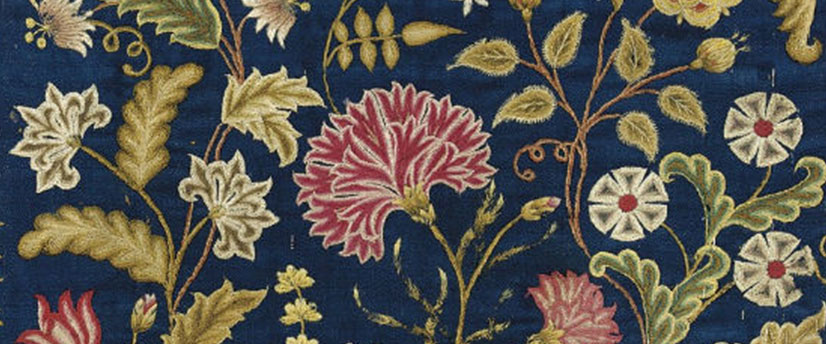


Though to some embroidery may still conjure up twee images of an outdated craft more favoured in a Jane Austen novel, the reality is actually far from that. In fact, that perception is as outdated as the people who still think this way.
Embroidery is no longer perceived as a simple parlour craft or a way to personalise a hanky. We are seeing it everywhere, from bespoke crafts and workwear to art and exhibitions and the Milan catwalks. The shift and change in the use of embroidery, especially with the generation of fast fashion and increasing customer demand, moves as quickly as the technology within the industry and awareness and application increases year on year.

Black Rhino ©Sophie Standing / www.sophiestandingart.com
Leading machine companies are firmly grasping these opportunities with both hands and today, embroidery machines are the most technologically advanced they’ve ever been. Fully automated, they are running quicker and quieter than before, allowing for multiple applications, new attachments and more needles per head. They’ve also adapted to the increase in customisation and have even evolved to the demand for hand-design techniques such as bead work and sequins, having single machines with the capability of doing more than one task.
We’re also seeing a change in the fashion industry in regard to embroidery. More mainstream fashion brands are incorporating it into their collections, maybe down to the ease of application these days from the advancements in machine technology. Whereas historically as a handcraft it was seen as more expensive, improvements in embroidery technology have made it cheaper and easier to achieve.

Check Embroidered Overcoat by Glamorous ©Topshop
But that doesn’t mean to say that it is only seen in fast fashion collections. Many of the design houses use embroidery to embellish and decorate designs and hand embroidery on top of machine embroidery is also popular. London Fashion week saw a number of emerging and established designers experimenting with embroidery in their 2019 Autumn / Winter collections. For example, Erdem Moralıoğlu, whose Princess Orietta Doria Pamphilj inspired collection featured shimmering embroidery as well as decorative embellishment, bows, veils and feathers.

Autumn/Winter 2019 Collection inspired by Princess Orietta Doria Pamphilj ©Erdem / erdem.com/en-gb/collections/autumn-winter-2019
As with many things, when technology enables, many like to go back to basics, so hand embroidery is also very much in the spotlight. Institutions like the Royal School of Needlework whose mission is to teach, practise and promote the art and techniques of hand embroidery mentor many up and coming embroiderers on their courses. They also run day classes, of which they open new ones across the country all the time. Their embroidery studio, based at Hampton Court Palace, creates beautiful bespoke commissions as well as working with historical textiles to conserve or restore them. Such projects have included working with Sarah Burton of Alexander McQueen on HRH The Duchess of Cambridge’s wedding dress and creating an epic six by four metre embroidery for Game of Thrones.
With all this in mind, the materials that are used to produce any embroidery in this day and age, whatever the application, have to be up to the job. Great design would ultimately fall down if the treads lacked in any way, shape or form. Here at Marathon Threads, our embroidery threads are quality, strong and carry environmental certifications. We stock viscose rayon and polyester threads as well as a selection of underthreads.
Top quality viscose rayon accounts for over 80% of all embroidery thread sales worldwide. Our viscose rayon has exceptional sheen and lustre and is soft to the touch. With a thread count of 120d/2 (40s), it is manufactured in our state-of-the-art factory, which has achieved ISO 9001 accreditation. In addition, the thread has achieved Oeko-Tex Standard 100 certification for environmental compliance in production. Used by many of the world's leading brands and garment manufacturers, it’s widely regarded as one of the best quality thread brands available. And with more than 360 colours including metallics and ombre shades, it’s easy to see why.
Our quality polyester thread has strength and an improved sheen and finish. With a thread count of 120d/2 (40s), it is manufactured in our state-of-the-art ISO 9001 accredited factory and has achieved Oeko-Tex Standard 100 certification for environmental compliance in production. Produced to withstand industrial detergents, it is widely used for garments or products which need be heavily laundered. And with 306 colours including fluo shades, there’s definitely lots of choice for design application.
Marathon thread performs superbly on Barudan, Tajima, ZSK, Brother, SWF and all other makes of industrial embroidery machines. In addition, because it is manufactured to perform on high speed industrial machines the results on Janome, Pfaff, Brother, Bernina, Husqvarna and all makes of domestic machines is excellent.
If you have any questions about our threads, how you will be using them or just want some advice on the right thread for the job, then please do get in touch. You can drop us a line via our online form or give us a call on 01773 741442.
Please note: The companies named in the above article are for illustrative purposes only and Marathon Threads are in no way suggesting any association.
Image credits
Cover image: Georgian embroidered panel – Courtesy Wikimedia Commons
Thumbnail image: Kersting embroidery woman (detail) – Courtesy Wikimedia Commons
Product categories
Customer services
Follow us


General information
Marathon Threads (Nottingham) Ltd
Marathon House
Tavistock Avenue
Ripley
Derbyshire
DE5 3SE
UNITED KINGDOM
+44 (0)1773 741442
© Marathon Threads 2026. All rights reserved. Site by One Studio